Introduction
Effective CV writing tips help job seekers create a professional resume that highlights their skills, experience, and achievements. A well-structured CV makes it easier for recruiters to assess a candidate’s suitability for the role and improves the candidate’s chances of securing an interview.
It highlights a candidate’s skills, experience, and achievements. This helps employers understand why a candidate may be suitable for a particular position.
However, preparing an effective CV goes beyond listing your qualifications and previous jobs. Candidates must organize all the basic information, such as name, designation, contact details, and professional summary, clearly. They must also highlight relevant skills, achievements, and tailor their CV according to the vacancy.
Creating a professional CV is only one part of the job search process. Candidates may also benefit from CV Distribution Services so that their profiles reach relevant employers and recruiters.
In this guide, we will learn how to make a professional CV and some important CV Writing Tips.
What is a CV and its importance for job seekers?
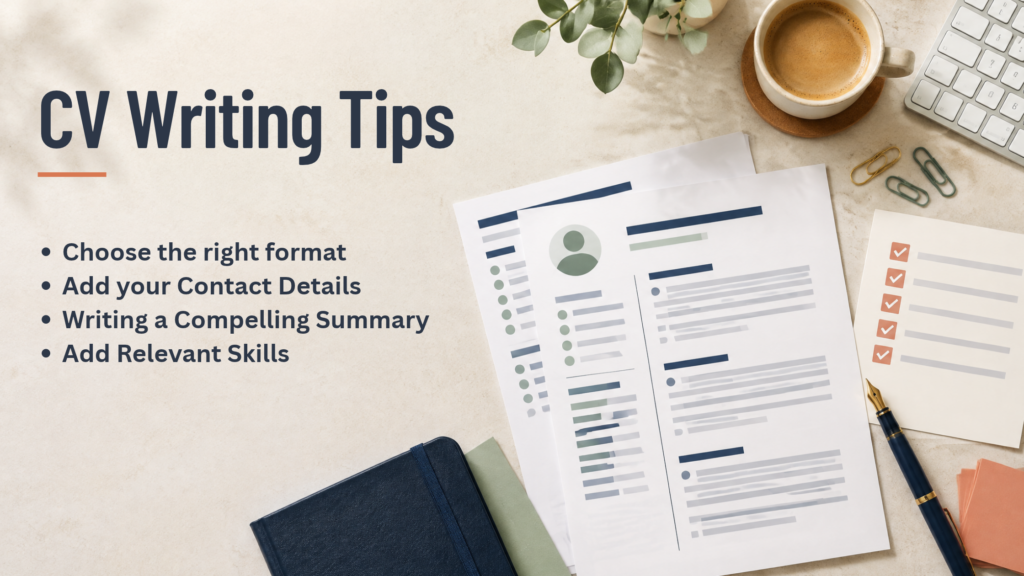
A curriculum vitae which is also known as a CV, is a professional document which helps in summarizing a candidate’s education qualifications, work experience, skills , certifications and other achievements.
Employers use it to understand a candidate’s qualifications and determine whether the candidate’s profile matches the requirements of the vacancy.
A strong CV can be beneficial for candidates due to the following reasons:-
- Presents the qualifications and experiences in an organized manner.
- Highlights skills that are relevant to a particular position.
- Demonstrates your professional achievements and development.
- Explains to recruiters why you are suitable for this position.
Your CV should make it easier for recruiters to find your strengths. The next section of the blog focuses on some of the most valuable CV writing tips that will make your CV stand out from other candidates.
Professional CV Writing Tips for Job Seekers
Although a good CV doesn’t always guarantee an interview, effective CV Writing can significantly improve the manner in which your profile is presented to potential employers. A well-structured CV highlights your skills, experience, and achievements in a clear and professional manner. This makes it easier for recruiters to assess a candidate’s suitability for a role.
It can also create a good and positive impression. This will increase a candidate’s visibility in a competitive job market and open doors to new career opportunities by encouraging employers to learn more about their background.
This section outlines some of the most common CV writing tips that can help you make a professional, well-structured, and easy-to-read CV.
Effective CV Writing presents a candidate’s skills in a much better and more organized manner. It also ensures that your profile is suitable and aligns closely with the requirements of the position you are applying for.
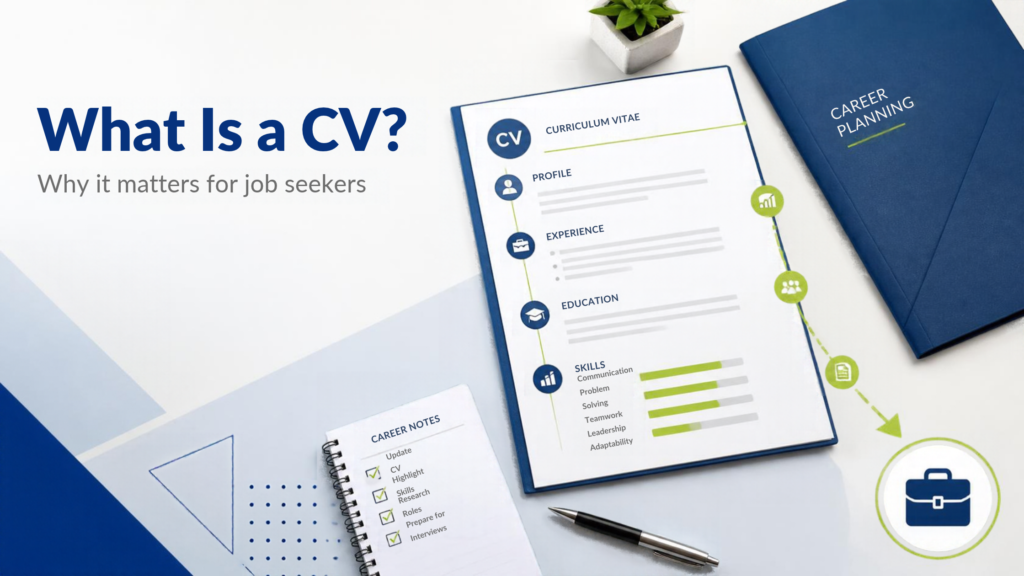
CV Writing Tips can enhance the overall impact of your CV and improve your chances of being noticed by the employer. Key CV Writing Tips are as follows:-
Choose the Right CV Format
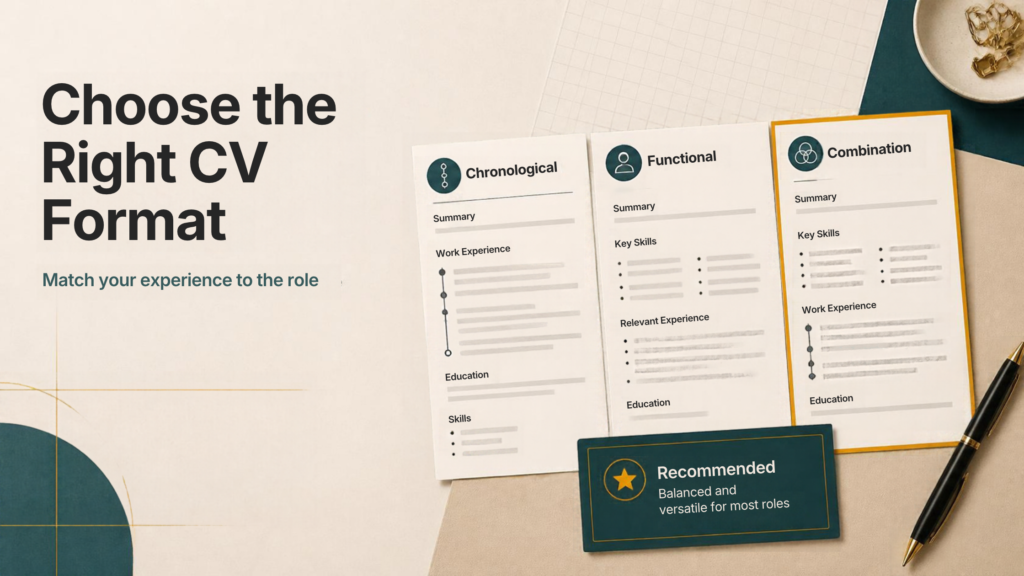
One of the first CV Writing Tips is to select a format that presents your experience, employment history, and career goals in a professional and organized manner. Three common CV formats are as follows:-
(a) Reverse Chronological CV
This type of CV lists your most recent work experience first, which is followed by earlier positions. It is a popular option and frequently used by candidates who have a consistent employment history.
Best suited for: Experienced professionals, candidates with relevant industry experience, and applicants who are progressing within the same field.
(b) Functional CV
A functional CV emphasizes skills and competencies rather than focusing primarily on employment dates. By highlighting transferable skills and relevant qualifications, a functional CV helps employers quickly identify strengths that match the requirements of the position.
Add your Contact Details
Write a Compelling CV Summary
A CV Summary is a short introduction that highlights your professional background, relevant skills, and career strengths. It must appear on top at the beginning of the document. This professional CV Summary helps recruiters understand the strengths of the candidates and what they can offer.
The professional summary shouldn’t be more than three to five lines. The ideal length of this professional summary depends on the role and the candidate’s experience.
A good summary should include the following:-
- Candidate’s professional background
- Most relevant experience
- Experience or participation in extracurricular activities
- Value the candidate brings to the position
Example for a fresher
Example for an experienced professional:
“Digital marketing professional with experience in content development, search engine optimization, and social media management. Skilled in creating audience-focused content, monitoring campaign performance, and supporting online visibility initiatives.”
Avoid generic statements such as “I am hardworking and looking for a challenging opportunity.” Instead, focus on specific qualifications and strengths relevant to the position.
With the help of these examples, candidates can understand how to tailor the professional summary according to different levels of experience. This is one of the most effective CV Writing Tips. Candidates should focus on highlighting their most relevant skills, achievements, and career objectives concisely.
Highlight Your Work Experience and Achievements
The work experience section helps employers understand the professional background and work done by the candidates in their previous companies.
It is preferred that candidates list their experience in reverse chronological order. They must begin by listing their most recent experience, followed by previous experiences. For each role, candidates must include the following details:-
- Job title.
- Company name.
- Location, where relevant.
- Employment dates.
- Relevant responsibilities and achievements.
Candidates must use concise bullet points to describe their work. They must focus on and include only those responsibilities that are relevant to the vacancy, instead of listing all their routine tasks.
The following are examples of weak and strong work experience statements that demonstrate how experience should be presented in a Professional CV:-
Weak example:-
- Responsible for writing blogs.
- Managed social media accounts.
- Created marketing content.
- Wrote and optimized blog articles using relevant keywords to support organic search visibility.
- Developed social media captions and visual content aligned with campaign objectives.
- Supported the creation of recruitment-related marketing materials for digital platforms.
Candidates must include measurable results supported by accurate data. They must mention the number of articles published, campaigns supported, or improvements in engagement if those figures are available and attributed to your work.
If you are a fresher with limited employment experience, then you must include relevant internships, volunteering, freelance assignments, and academic projects. These experiences can demonstrate practical skills and your readiness to enter the workplace.
Include Your Educational Qualification
Mentioning educational qualifications is important for fresh graduates, students, and candidates applying for positions that require specific academic qualifications.
Candidates must list their educational qualifications in reverse chronological order. For each qualification, candidates must mention the following details:-
- Degree or qualification.
- Institution name.
- Location, if relevant.
- Graduation year or expected completion date.
- Relevant academic achievements, where appropriate.
Highlight Relevant Skills
The skills section should clearly highlight the abilities, competencies, and expertise that make a candidate relevant for the advertised position. Include skills that are directly relevant to the role and demonstrate how your qualifications, experience, and strengths align with the employer’s requirements.
Skills can be divided into two broad categories:-
Technical skills
Technical skills can be defined as job-specific abilities that enable candidates to perform tasks using particular tools, software, methodologies, or industry practices.
These skills are typically acquired through education, training, certifications, or hands-on experience and demonstrate a candidate’s ability to carry out role-related responsibilities effectively.
Examples:
- Search engine optimisation (SEO).
- Microsoft Excel and PowerPoint.
- Canva and graphic design tools.
- Data analysis.
- Content management systems.
- Video editing software.
- Project management tools.
Soft Skills
Soft skills are personal and professional attributes that influence how individuals communicate, collaborate, solve problems, manage responsibilities, and adapt to the workplace environment.
These transferable skills demonstrate a candidate’s ability to work effectively with others, handle challenges, maintain productivity, and contribute to the organization’s goals. These competencies make a candidate an important component of overall workplace performance and career success.
Examples:-
- Written and verbal communication.
- Teamwork and collaboration.
- Problem-solving.
- Time management.
- Adaptability.
- Attention to detail.
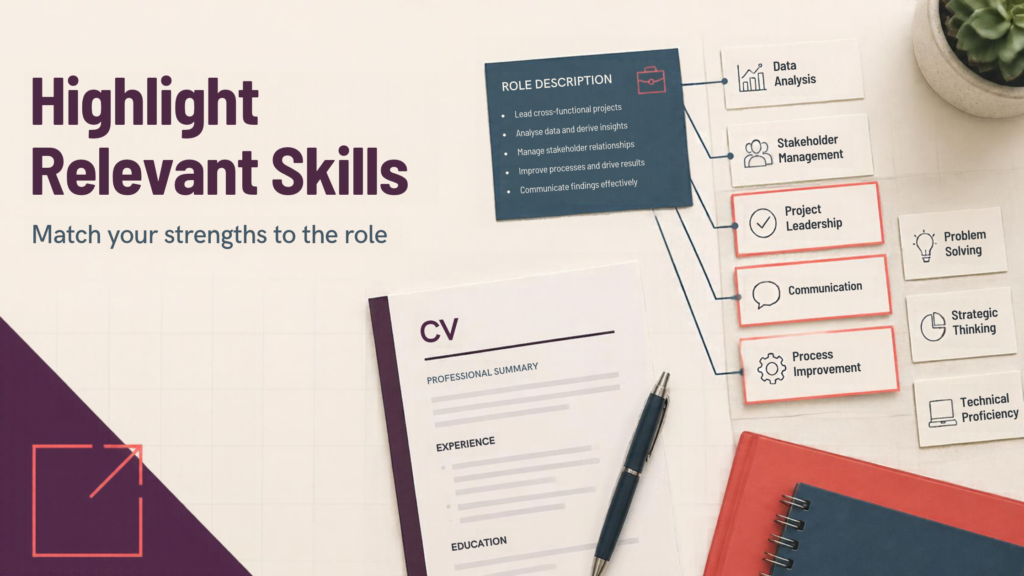
Mention skills based on the job description instead of including irrelevant skills. Whenever possible, candidates must demonstrate important skills through their experience or other relevant academic projects.
Candidates must be sure about their proficiency level in each skill. They should also be able to explain each skill during an interview.
Tailor Your CV to Every Job Application
Tailoring your CV to every job vacancy that you apply to is one of the most important CV Writing Tips.
Recruiters want to understand how your background aligns with the role, instead of a generic summary that explains what you have done so far.
Before applying, candidates must carefully read the job description and identify the following:-
- Key responsibilities.
- Essential and preferred qualifications.
- Required technical skills.
- Relevant industry experience.
- Important terms used in the advertisement
Candidates must review their CV and adjust the professional summary, skills, and experience sections to highlight their most relevant qualifications. For example: A candidate applying for a content writing position should emphasize writing skills, editing skills, SEO knowledge, and the number of articles published.
If the same candidate is applying for a social media position, they may emphasize content creation, content calendars, and campaign support.
Tailoring your CV doesn’t mean changing facts or creating a different professional history for every employer. It means presenting your experience in a way that addresses the employer’s requirements.
To add to this, customizing your CV for each application can help demonstrate your suitability for the role and improve its relevance to employers. For additional guidance, candidates can review Indeed’s guide on tailoring a resume to the job description.
Conclusion
Following the above-mentioned practical CV Writing Tips can help you make a professional CV that clearly presents your qualifications, skills, education, and work experience. Choosing the right format, highlighting relevant achievements, and tailoring your CV to each application can improve your chances of attracting employer attention.
A well- crafted CV can strengthen your job applications and help employers identify your suitability for the role. Taking enough time to present your qualifications effectively can support your long-term career goals.
Frequently Asked Questions (FAQs)
How long should a CV be?
A CV is generally one page for fresh graduates and candidates with limited experience. Professionals with several years of relevant experience may need two pages.
What are the most important sections of a CV?
Essential sections in a CV include contact details, a professional summary, education, relevant skills and work experience. Candidates can also add additional sections such as certifications, projects, achievements and languages known if they support and enhance your application.
How can I make my CV ATS-friendly?