Introduction
Recruiting the right candidate is the first step in building a successful workplace. Effective employee onboarding ensures that new hires understand their responsibilities, adapt to the workplace and become productive members of the organization.
In the UAE’s competitive employment market, a structured onboarding process creates a positive employee experience, boosts engagement, reduces early turnover and supports long-term success.
From completing employment formalities to providing role-specific training, every stage of onboarding helps employees to integrate smoothly in their new roles.
This guide explores seven practical employee onboarding practices in the UAE that can help organizations build stronger working relationships and a more productive workforce.
| S. No. | Contents |
|---|---|
| 1 | Introduction |
| 2 | What Is Employee Onboarding and Why Is It Important for Business Success? |
| 3 | 7 Employee Onboarding Best Practices |
| 3.1 | Plan and Organize the Employee Onboarding Process in Advance |
| 3.2 | Create a Welcoming First-Day Experience |
| 3.3 | Establish Clear Roles and Performance Expectations |
| 3.4 | Provide Structured Training and Development |
| 3.5 | Assign a Mentor or Onboarding Buddy |
| 3.6 | Maintain Regular Communication and Feedback |
| 3.7 | Personalize the Onboarding Process |
| 4 | Common Employee Onboarding Mistakes Employers Should Avoid |
| 5 | Conclusion |
| 6 | Frequently Asked Questions (FAQs) |
What Is Employee Onboarding and Why Is It Important for Business Success?
Employee onboarding is a structured process of integrating newly hired individuals into the organization. It begins after a candidate accepts a job offer and continues through the initial stages of employment. It helps employees to become familiar with their roles, colleagues, workplace policies, and company culture.
Employee onboarding involves continuous communication, training and support. It ensures that employees have the information, resources and guidance required to perform their responsibilities confidently.
For UAE employers, an effective onboarding strategy is important because workplaces often bring together professionals from different countries, industries and cultural backgrounds. New hires may need to become familiar with local employment requirements, organization’s policies and communication practices.
A consistent onboarding experience offers several advantages. These are as follows:-
(a) Improved Employee Engagement
Employees who feel welcomed and supported are more likely to develop a positive connection with their workplace.
(b) Faster Workplace Integration
Clear instructions and structured training helps new hires understand their responsibilities quickly.
(c) Better Employee Retention
A positive joining experience can reduce uncertainty and improve an employee’s willingness to remain with organization for a long-time.
(d) Increased productivity
Providing the right tools, resources and guidance allows employees to focus on their responsibilities.
(e) Stronger Organizational Culture
Introducing workplaces and setting expectations helps employees to understand how the organization operates, this encourages them to align their behaviour and performance with the company standards from the beginning.
Ultimately, employee onboarding should be treated as an investment in workforce development. It shouldn’t be treated as an administrative task that ends on employee’s first day.

1.Plan and Organize the Employee Onboarding Process in Advance
A successful onboarding experience begins before the employee walks into the office. Effective Interview Coordination helps maintain clear communication throughout the hiring process and ensures a smooth transition from candidate to employee.
Proper preparation helps employers avoid unnecessary delays and ensure that new hires have all the necessary resources and tools before executing their responsibilities.
After the candidate accepts the job offer, the HR department should begin the necessary pre-joining procedures. These procedures may include collecting relevant documents, coordinating employment formalities, preparing the workstation, and informing the concerned departments about the new employee’s arrival.
In the UAE private sector, employers must follow the applicable work permit and employee contract procedures. The formal job offer should be signed by both parties, and the required work permit should be obtained before the employee starts working.
Some important pre-joining activities include:-
(a) Complete Employment Formalities:-
HR Mangers and recruiters must coordinate and keep a track of the required work permit, employment contract and applicable residency formalities.
(b) Collect the Necessary Documents
Recruiters must collect the relevant identification, education qualifications, professional certificates and other documents required for the role.
(c) Arrange Workplace Essentials
Ensure that the employee’s workstation, email account, system access, identification credentials, and the required software are fully setup before they arrive on the first day.
(d) Inform the relevant departments
Notify the HR, IT administration and the reporting manager about the employee’s joining date.
(e) Share the joining information
Recruiters should provide employees with clear instructions about their reporting time, workplace location, dress code, and required documents to bring on their first day. This helps to ensure a smooth and organized employee onboarding experience while reducing uncertainty for new hires.
2. Create a Welcoming First-Day Experience
An employee’s first day can significantly influence their perception of a new workplace. An unorganized onboarding experience, unclear instructions or a lack of communication may create unnecessary uncertainty. On the other hand, a warm welcome helps new hires feel comfortable and confident about their decision to join the organization.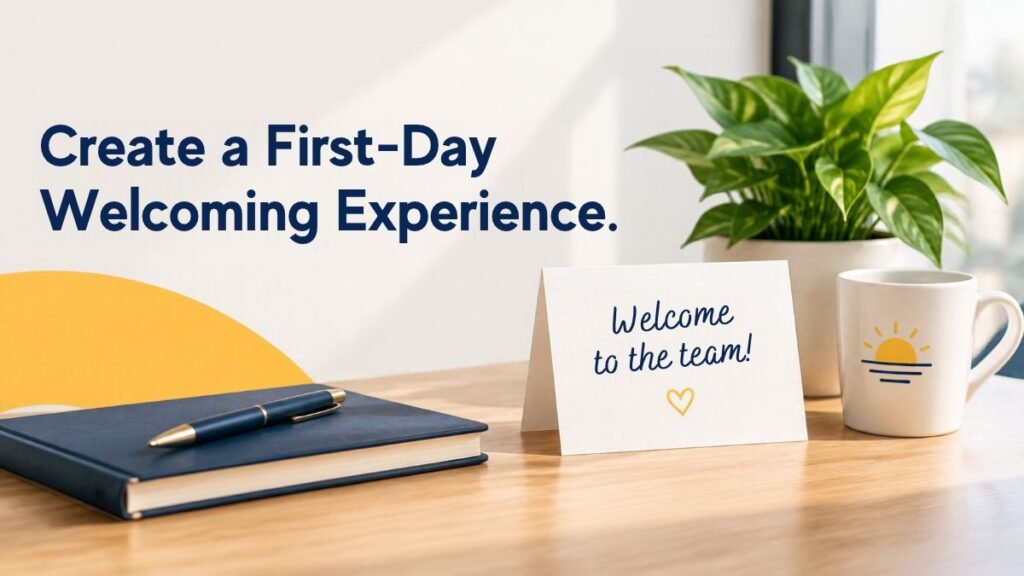
HR professional and reporting managers should work together to make the first day informative. However, they should not bombard the new hire with a lot of information which makes it difficult for them to retain, understand and execute it.
Start by welcoming the new hire and introducing them to the people they will interact with regularly. A brief office tour can help them understand the workplace layout, meeting rooms, break rooms and other essential facilities.
Consider incorporating the following activities into the first-day schedule:-
(a) Welcome the employee and introduce them to their reporting manager.
(b) Introduce them to immediate colleagues and relevant departments.
(c) Provide an overview of the company’s history, services and organizational structure.
(d) Explain workplace policies, attendance procedures and communication channels used to share information with fellow employees.
(e) Demonstrate how to use essential office facilities and internal systems.
(f) Share the employee handbook or company guidelines.
A well-planned first-day experience helps employees feel welcomed, informed and confident in their new roles. Clearly explaining the workplace practices, organizational expectations and support channels lead to a smooth employee onboarding process. This encourages new hires to integrate quickly and become active members of the team.
3. Establish Clear Roles and Performance Expectations
One of the most important aspects of employee onboarding is to ensure that new hires have understood their roles, responsibilities, performance expectations and reporting time from the beginning.
Even experienced professionals may need guidance when joining a new organization because responsibilities, reporting structures, and internal process can vary from company to company.
With clear targets and expectations set, employees may struggle to prioritize tasks and understand performance requirements.
To avoid confusion, managers should conduct an initial role-orientation meeting. During this discussion, they should explain the employees primary responsibilities, reporting managers, immediate prioritizes, and expected outcomes.
Employers should consider the following practices:-
(a) Provide a detailed job overview
Employers should explain daily responsibilities, key deliverables, and the specific duties which employees should follow in their roles.
(b) Establish measurable objectives
Set realistic short-term goals that employees can work towards in the initial months when employees have joined the organization.
(c) Clarify reporting structures
Identify the reporting manager, team members and departments involved in daily operations.
(d) Discuss key performance indicators
Provide clean guidance on performance expectations. This includes productivity, work quality, deadlines and the key metrics used to assess success in the role.
Managers should avoid assigning a lot of work immediately after joining. Instead, they should allow new hires to adapt according to their responsibilities and work culture of the organization. When targets are set, employees can prioritize tasks effectively. They can also take ownership of their responsibilities and contribute more efficiently to organization’s goals.
4. Provide Structured Training and Development
Even highly qualified candidates need time to understand an organization’s internal systems, processes and expectations. Providing a structured training during the onboarding helps in bridging this gap. It enables employees to adapt more quickly to their roles and develop the knowledge and confidence required to perform their responsibilities effectively.
Training requirements will differ according to the position, industry and level of experience. While some employees may require technical guidance, others may benefit from learning about customer service standards, internal reporting systems, tools and workflows employees will use to execute their day-to-day tasks.
A structured training program may include:-
(a) Job-specific training:
Introduce employees to the tools and systems, employees will use in their day-to-day responsibilities. Additionally, reporting managers should also train new hires in new tools and workflows that employees should know to perform their tasks efficiently.
(b) System Orientation
Reporting managers should demonstrate to employees how to use company software, communication tools and internal management systems.
(c) Workplace Compliance
HR Manager and the reporting manager should conduct an initial briefing session. In this session, they must explain the company policies, confidentiality requirements and applicable regulatory procedures.
(d) Health and safety training
Reporting managers should explain workplace safety guidelines and also provide appropriate instructions based on the employee’s working environment.
(e) Professional development
Employees should identify opportunities which help in strengthening their communication, problem-solving, leadership and other skills. Continuous skill development can contribute to professional growth and enhance overall job performance.
A structured training helps employees gain the knowledge and skills required to perform their roles confidently and efficiently. Employers can also refer to employee onboarding best practices published by SHRM to strengthen their onboarding programs.
5. Assign a Mentor or Onboarding Buddy
Starting a new job involves learning new tools, understanding team dynamics, and adjusting to a different personal environment. While HR teams provide administrative support, new employees may benefit from having an experienced colleague who can guide them through everyday workplace activities.
An onboarding buddy is generally is generally an existing employee who helps the new hire become familiar with the workplace. They can answer routine questions and introduce the employee to colleagues and the various team activities.
On the other hand, a mentor may provide a more structured professional guidance to employees entering senior positions.
To make this process effective, employers should do the following:-
(a) Select an appropriate and experienced member.
(b) Explain the mentor’s responsibilities before the new employee joins.
(c) Encourage regular communication during the first few weeks.
(d) Give opportunities to new hires so that they can observe and learn from experienced colleagues.
(e) Allow employees to ask questions without making them feel uncomfortable.
This approach is beneficial for multicultural teams where employees have different professional background and communication styles. Assigning a mentor during the employee onboarding process can strengthen workplace relationships, encourage collaboration, and help new adapt more comfortably into a new workplace.
6. Maintain Regular Communication and Feedback
Employee onboarding should extend beyond the first day or week. New hires need ongoing support as they are adjusting and learning their responsibilities, workplace culture and, organizational expectations.
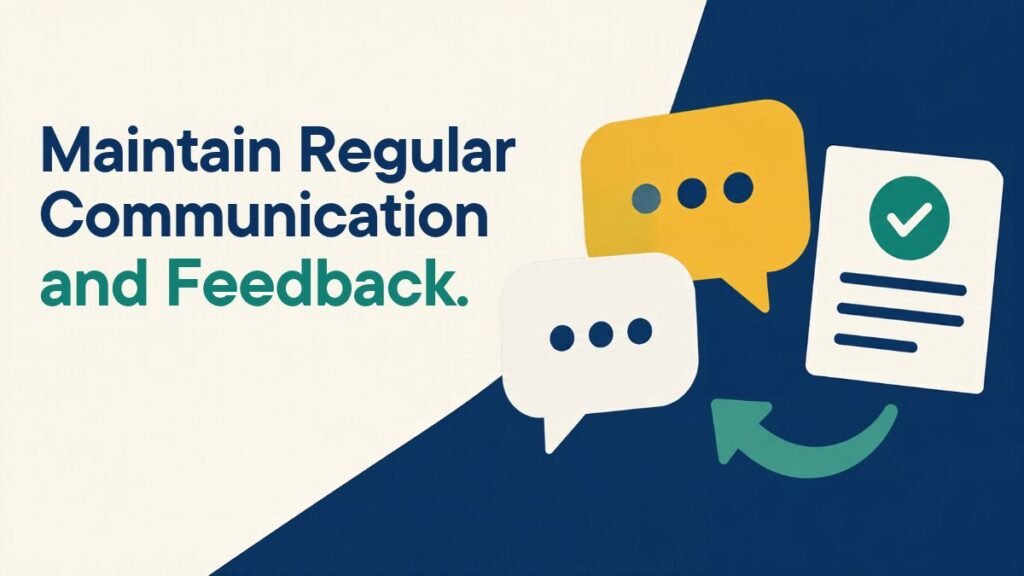
Regular check-ins by reporting manager and HR Managers on employees can help them identify challenges early and ensures employees are progressively confidently in their new roles. They can schedule meetings at the end of the first week, first month and third month to review progress and address any concerns.
During these conversations, managers should assess whether employees understand their responsibilities, have access to necessary training and resources, and feel supported in their role. Employees should also be encouraged to share their feedback, raise concerns and seek clarification whenever needed.
This input helps organizations identify challenges early and provide support to ensure a smooth onboarding experience.
7. Personalize the Onboarding Process
Although organizations should maintain consistent onboarding standards, but they should also keep in mind other factors such as difference in employee roles, experience level and professional background.
A newly graduated employee may need more guidance than an experienced manager, while a technical professional may require may need specialized training than an administrative employee may not need.
Personalizing onboarding helps organizations to provide adequate support without overwhelming new hires with unnecessary information.
Employers can make the experience relevant by considering the following strategies:-
(a) Adapt training to job requirements
Employers must make learning plans based on the employee’s responsibilities, technical knowledge and expertise.
(b) Consider prior experience
Avoid repeating information that experienced employees already understand. However, employers must provide new and additional information wherever necessary.
(c) Provide role-specific resources
HR and reporting managers should share relevant manuals, process documents, software guides, and departmental information.
(d) Consider Cultural Differences
Explain communication styles, workplace etiquettes, and organizational practices to employees who are joining from different professional background.
(e) Set individual learning milestones
Employers must set realistic targets for employee’s which will reflect their position and development needs.
Personalized employee onboarding makes the transition efficient by focusing on what each employee needs to understand and accomplish. It also demonstrates that the organization recognizes individual contributions and its committed towards supporting professional development.
Common Employee Onboarding Mistakes Employers Should Avoid
Even organizations with established HR departments can struggle to onboard new employees. Overlooking a few aspects of employee onboarding may affect employee confidence, workplace integration and overall productivity.
Some common mistakes include:-
Treating onboarding as a one-day activity:
Limiting the process to document collection and a brief introduction, leaves employees without sufficient guidance during initial months.
Setting unclear job expectations:
Employees may struggle to prioritize responsibilities. This happens when managers fail to communicate objectives and performance requirements clearly.
Overloading new hires with information:
Providing a lot of information can also be problematic. If managers share too many policies, procedures and instructions at once, then it can become difficult for employees to retain important information.
Ignoring employee feedback
Avoiding or failing to address employee questions can lead to a negative impression. It can lead to frustration and reduced productivity and engagement from employees.
Neglecting training requirements
Employers often assume that previous experience is sufficient. Due to this, they think that there is no need to provide additional training to employees. This may prevent employees from understanding the organization’s work culture, systems and communication tools. It can reduce productivity and engagement.
Delayed administrative arrangement
Incomplete documentation, unavailable equipment or delayed system access can lead to frustration. It also reduces productivity and makes it difficult for employees to perform their responsibilities efficiently from the outset.
Avoiding these mistakes requires coordination between HR professionals, reporting managers and other departments. A well-defined onboarding process helps organizations provide consistent guidance and support to new employees.
Conclusion
Effective employee onboarding plays a key role in building a productive, engaged and stable workforce. By combining proper employment formalities, structured training, clear communication, and ongoing support, organizations can help new hires smoothly transition into their roles.
A well-planned employee onboarding process improves their performance, retention and experience while contributing to overall organizational success.
Frequently Asked Questions (FAQs)
What is employee onboarding?
Employee onboarding is the process of integrating newly hired employees into an organization. It involves completing employment formalities, introducing workplace policies, providing training ,and helping employees understand their responsibilities.
What documents do you need for employee onboarding in UAE?
Depending on the employee’s circumstances and job requirements, the requirements may vary from company to company. However, common documents include a passport copy, visa or residency details, Emirates ID, signed job offer, employment contract, educational certificates and relevant professional qualifications.